
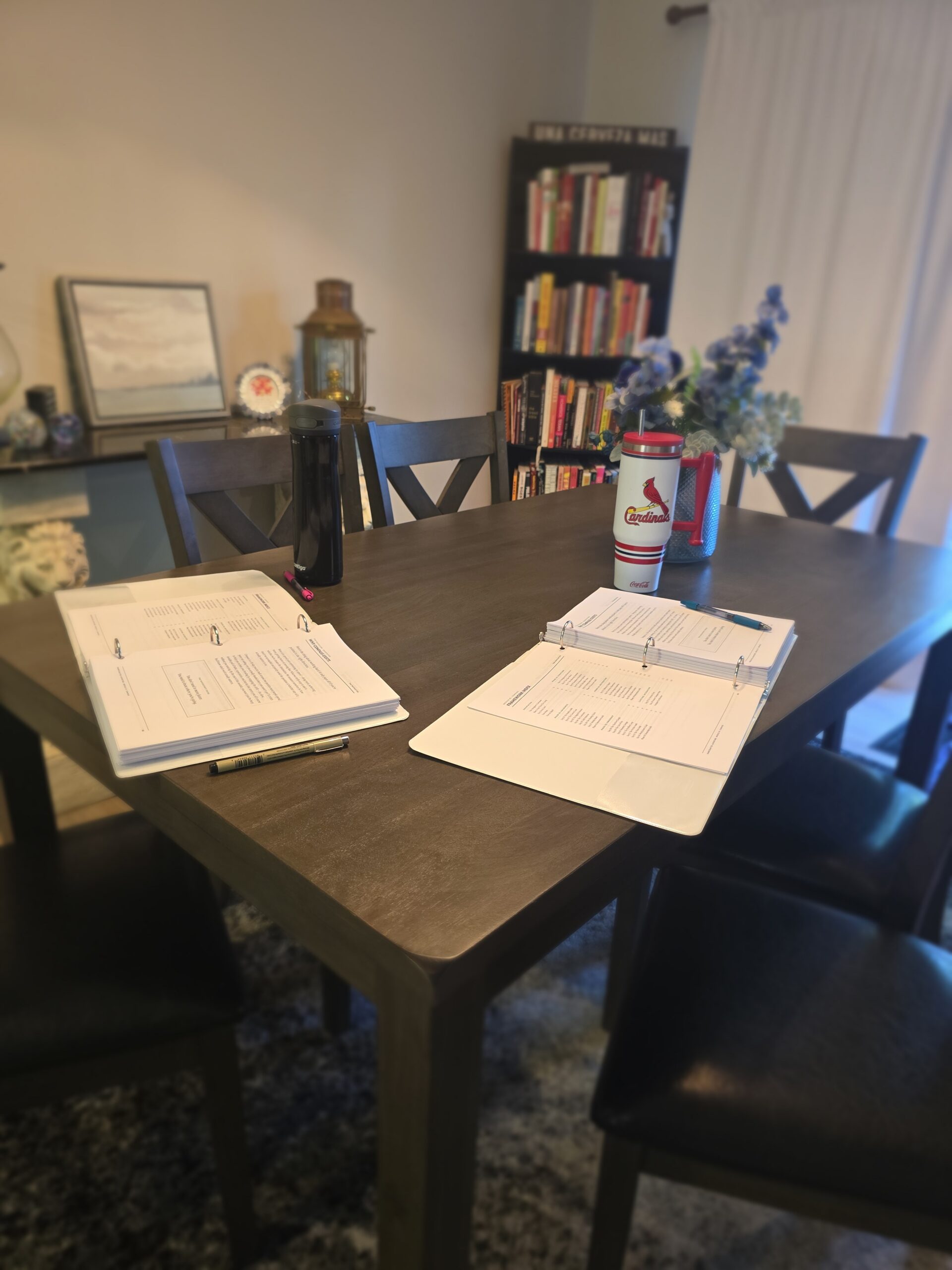
I want to tell you something about the heading exercise that I didn’t expect.
I thought it would feel clarifying. Like the moment you finally name something that’s been circling, and suddenly the room gets clearer. That’s the version I had in my head going in — a small revelation, a sentence I’d write down and immediately recognize as true.
What actually happened was more uncomfortable than that.
The first time I did the heading exercise — Day 6 of the workbook, about a week into the run — I wrote something that sounded right. It had the right words in it. It was the kind of sentence I’d be comfortable saying out loud at dinner. And when I read it back, I felt almost nothing.
Which is, it turns out, a signal.
The workbook pushes you past the first version. The one that sounds right but doesn’t cost you anything.
I wrote three more versions before I got to one that made me put the pen down for a minute.
That one I’m keeping private. But I can tell you what it felt like: true in a way that was slightly inconvenient. Not dramatic. Just more specific than comfortable.
What Week Two Actually Looked Like
Day 14. Module 1, Phase 2 — Ownership. The heading is named. Now the work is figuring out what’s getting in the way of it.
BIL #1 was about the decision to start — the kitchen table moment, the sense that we weren’t lost exactly but weren’t quite found either. BIL #2 was about what the first full week actually produced: small things, mostly. A different route. Time in the garden. Rest that was chosen rather than collapsed into.
Week two has been harder to write about cleanly because it hasn’t been clean.
I’ve been running busy shifts at work. I overdid it in the yard last weekend — the kind of overdoing that catches up with you two days later when you’re trying to get out of bed at 4am. And I’ve been playing catch-up on sleep in a way that means some mornings the framework work happened and some mornings it didn’t.
That’s the version I want to record here, because the whole point of doing this in public is to tell the actual story — not the performed one.
What I’ve noticed is that the Ownership phase meets me exactly where that struggle lives. Phase 2 isn’t about finding your heading anymore — that happened in week one. It’s about looking honestly at what you’re carrying and whether you actually chose any of it.
What Ownership Phase Is Actually Asking
The workbook calls this the Vital Few — the commitments that actually move you toward your heading. Everything else is noise or accumulation.
What it’s asking, practically: what are you actually carrying? What did you choose versus what accumulated? What’s the protected thing — the one that holds even when everything else is negotiable?
I don’t have clean answers to all of those yet. I have partial ones.
The 4am workout holds. Not because I’m disciplined in some general sense, but because it happens before the rest of the day has opinions. The yard holds — in small doses — until I push it past the point where it costs me the next two mornings. The Sunday debrief with Tom is becoming one of the more useful weekly conversations we’ve had in years.
What I’m still working on is the cost of yes. The workbook has a specific exercise on this. It’s not a comfortable one to sit with. You see pretty quickly where the drift is actually being manufactured, and it’s usually not by external circumstances.
It’s usually by you. By the small comfortable yes that seemed reasonable at the time.
What This Is Actually Like to Do
If you’re wondering whether you could run this framework while also working full time and managing a real life with actual competing demands — the answer so far is yes, with an asterisk.
The asterisk is: it won’t look like the ideal version. Some days will be partial. Some weeks will be harder than others. The consistency you’re building is not about doing it perfectly every day. It’s about the return — noticing when you’ve drifted off the work, and coming back without drama.
That return, in the workbook, has a specific name. And by Day 14 I’ve practiced it enough times that it’s starting to feel less like failure and more like the practice itself.
The return is the practice.
Week three starts this weekend. Phase 3 — Structure — is next. I’ll report back.
If any of this is resonating, Monday’s post goes deeper on the longer arc — what it actually looks like to let go of the life you accumulated and start building the one you’d choose. And Wednesday’s post is the practical companion — what living more deliberately actually requires of the body this week.
The beta opens September 2026 — 90 days, three modules, a small founding group. If you want to be first to know when the doors open, get on the waitlist here.