

Financial clarity is the first step toward turning overwhelm into action and uncertainty into confidence. Money can feel messy—bills, debt, savings, retirement. No wonder so many of us avoid looking too closely.
I used to do the same. Every time I thought about “getting serious” with money, I felt overwhelmed before I even started.
But here’s the truth: the hardest part isn’t the math. It’s the not knowing.
The moment I finally sat down and put everything on one page, I felt lighter. Not because all my problems were solved, but because clarity gave me options. And when you know where you stand, you can finally decide where you’re going.
Here’s how to create that clarity—without spreadsheets, jargon, or overwhelm.
Note: This post includes affiliate links. That means if you choose to purchase through my links, I may earn a small commission—at no extra cost to you. It helps support Handcrafted Adventure so I can keep sharing free tips, stories, and guides with you. Thanks for being here!

Step 1: Write Down the Five Basics
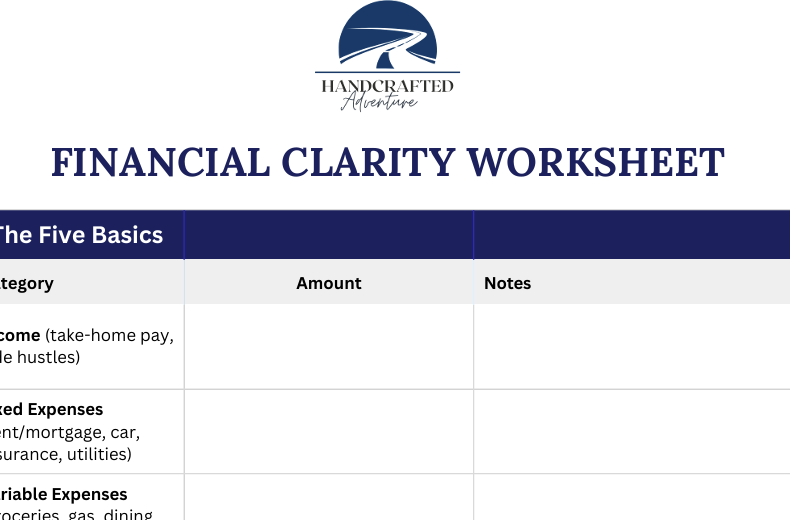
Grab a notebook or download my free Financial Clarity Worksheet. It can be helpful to understand where your money is going — not to control every detail, but to reduce the mental noise around it. You only need five categories to see your full picture:
- Income – What actually comes in each month.
- Fixed Expenses – Mortgage/rent, car payment, insurance, utilities.
- Variable Expenses – Groceries, gas, eating out, subscriptions.
- Debt – Credit cards, loans, balances, and minimum payments.
- Savings & Investments – Emergency fund, retirement accounts, short-term savings.
Want a deeper dive? Try the NerdWallet Budget Calculator to plug in your own numbers

Step 2: Add Assets and Liabilities
This isn’t about perfection—it’s about perspective. Take a quick snapshot of:
- Assets: cash, home equity, retirement balances, savings accounts.
- Liabilities: car loan, mortgage, credit cards, student loans.
This is your net worth snapshot. Even if the number is negative, don’t panic—clarity today is what helps you improve tomorrow.

Step 3: Gather, Don’t Perfect
Don’t get stuck chasing every penny. Just grab:
- Your most recent bank statement
- Loan balances
- One month of bills
If it takes more than 30 minutes, you’re going too deep. Think snapshot, not audit.

Step 4: Look for the Levers
Once it’s all laid out, patterns jump out:
- Are fixed expenses eating up more than 60% of your income? That leaves very little breathing room.
- Is your grocery bill higher than you thought?
- Do you have one debt with a painful interest rate?
These are your levers—the places where one small change can free up momentum.
Curious about debt payoff? Here’s a simple guide to the Debt Snowball vs. Debt Avalanche.

Step 5: Take One Small Action
Clarity is only powerful if you move on it. Don’t try to fix everything today. Just pick one step:
- Cancel a subscription you don’t use.
- Move $50 into savings (try an online high-yield savings account).
- Call your credit card company and ask about lowering your rate.
For savings, most experts recommend 3–6 months of expenses as a cushion. If that feels out of reach, don’t let it stop you—start small. Even $25 a month builds momentum. You can explore your own goal with the Fidelity Emergency Fund Calculator.

Step 6: Connect It to Your Bigger Why
Numbers are just numbers until you link them to what you actually want.
- Dreaming of a career change? You’ll need a runway.
- Want to downsize? Clarity shows what’s realistic.
- Craving more travel or adventure? Your money map makes that possible.
Getting clear isn’t about restriction—it’s about freedom. Freedom to choose, to pivot, to create the life you imagine.
See Related Posts:
- Redefining Success: What If It’s Not What You Thought?
- Staycation Magic: How to Explore Your Town Like a Tourist

My Own Wake-Up Call
When I went back to school, my small income disappeared. Tom carried the weight of being the primary provider, which meant the extras we were used to—eating out, spontaneous trips, even little “fun money” purchases—were suddenly off the table.
At first, I felt guilty for not contributing. Then I felt frustrated at how tight things got. But when we sat down and mapped it all out, I realized something important: even with limited wiggle room, having a clear picture gave us options. We could see what to trim, where to shift, and how to protect the things that mattered most.
That season reminded me that clarity isn’t just for the good times—it’s what gets you through the lean ones.
A Simple Tool to Get You Started
I created a Financial Clarity Starter Sheet to make this step as simple as possible. It’s one page, clean, and easy to use—no overwhelm.
✨ Ready for clarity?
👉 Download your free Financial Clarity Worksheet here
This is the same tool I used to finally face our numbers, and it’s what I return to whenever things start feeling fuzzy.

Final Thought
You don’t have to solve everything today. Just shine a light on what’s real, take one small step, and keep walking forward.
Clarity first. Freedom next.
What’s one area of your finances you’ve been avoiding that you’re ready to face? Share it in the comments—I’d love to cheer you on.
That same idea shows up in how clarity often comes from small, repeatable systems rather than big bursts of motivation — something I explore more in
Systems Beat Willpower.
A quiet note before you go
Financial clarity isn’t about having everything figured out. It’s about reducing the background noise so your energy can go toward the life you’re actually trying to build.
This post is part of the Mindset & Reinvention pillar at Handcrafted Adventure — a space for reflection, clarity, and change that unfolds gradually, not all at once.
If you’d like a few quiet, practical resets delivered by email, you can choose a simple starting point here:
→ Explore the Mindset & Reinvention free guides
When you’re ready for deeper structure
If you’re ready for something steadier to return to, the Life Reinvention Planner & Workbook offers supportive structure for clarity, direction, and realistic next steps — without forcing a total overhaul.
→ View the Life Reinvention Planner & Workbook
Related reading
Explore the full Mindset & Reinvention pillar here.
A quick note on approach
The Mindset & Reinvention pillar is designed to support reflection, clarity, and intentional change — not to replace professional guidance. The ideas and tools shared here are meant to help you notice what’s shifting, think more clearly, and take realistic next steps. Everyone’s circumstances are different, and you’re always encouraged to seek qualified support when navigating major life, health, or financial decisions.
Disclaimer: I’m not a financial advisor. The ideas and tools I share here are based on my own experience and research. They’re meant for education and encouragement—not as professional financial advice. Always do your own research or speak with a qualified financial professional before making big decisions with your money.